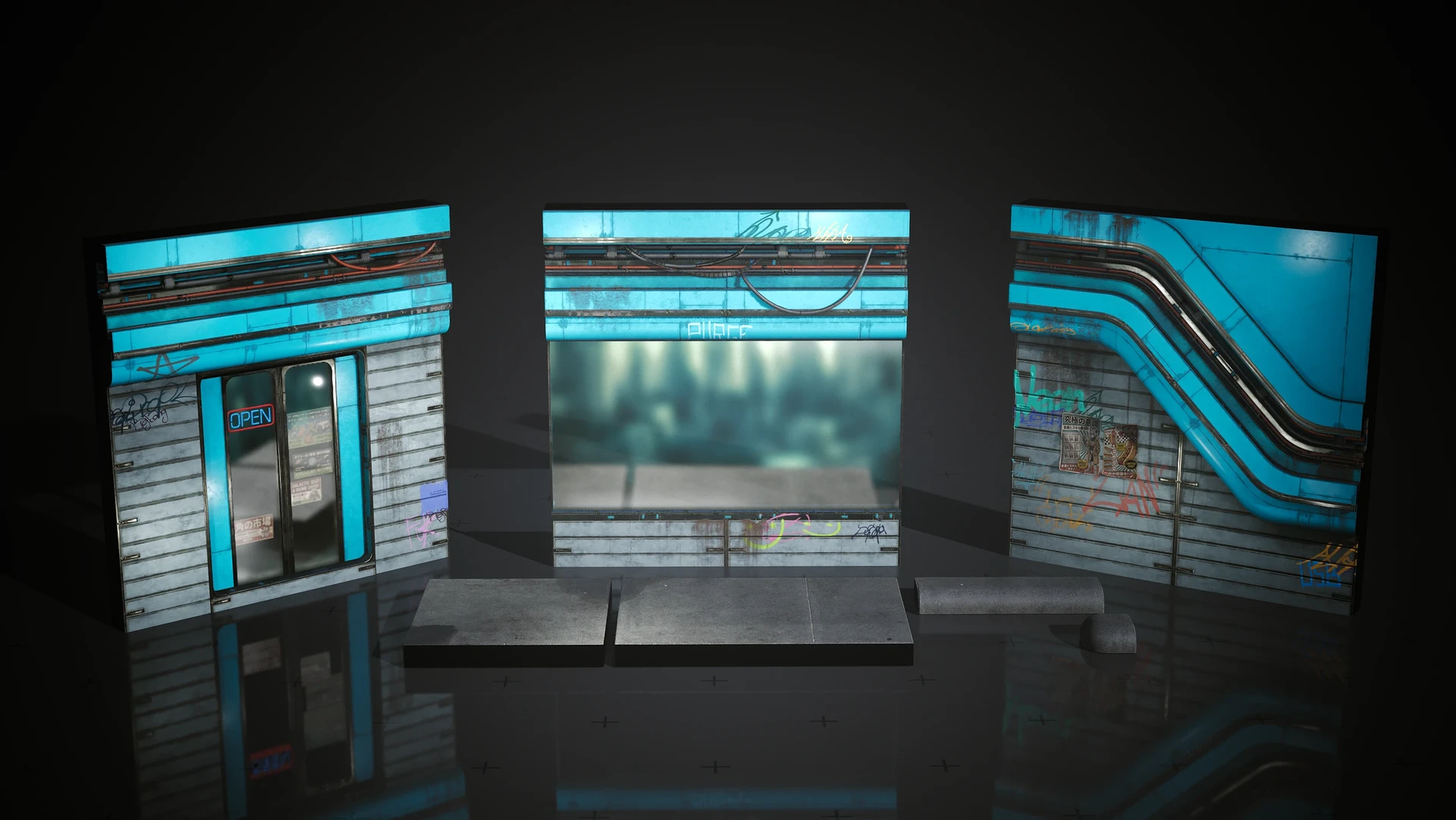
Modular Set Breakdown
For this project, I focused on building a scalable and flexible workflow that could support fast iteration without sacrificing visual consistency.
Graffiti and leaks were handled through a semi procedural blueprint system, allowing for non-destructive iteration and consistent detail across modular assets. This made it easy to iterate quickly without needing to revisit the meshes.
Materials were built using a layered setup driven by ID maps authored per asset. This provided clear control over material regions and made it easy to swap or refine surface treatments across the set while keeping everything cohesive during lookdev.
For dirt and wear, a distance field–based approach was used to drive cavity and top-layer accumulation, helping surfaces respond more naturally to their environment. This reduced the need for baked detail and shifted more of the work into the material layer, where it could be adjusted more easily.
Overall, the workflow stayed flexible and scalable, allowing for faster iteration and making it easier to dial in the final look with minimal manual rework.
For the full scene assembly, check it out here:
https://www.artstation.com/artwork/4NmVQY